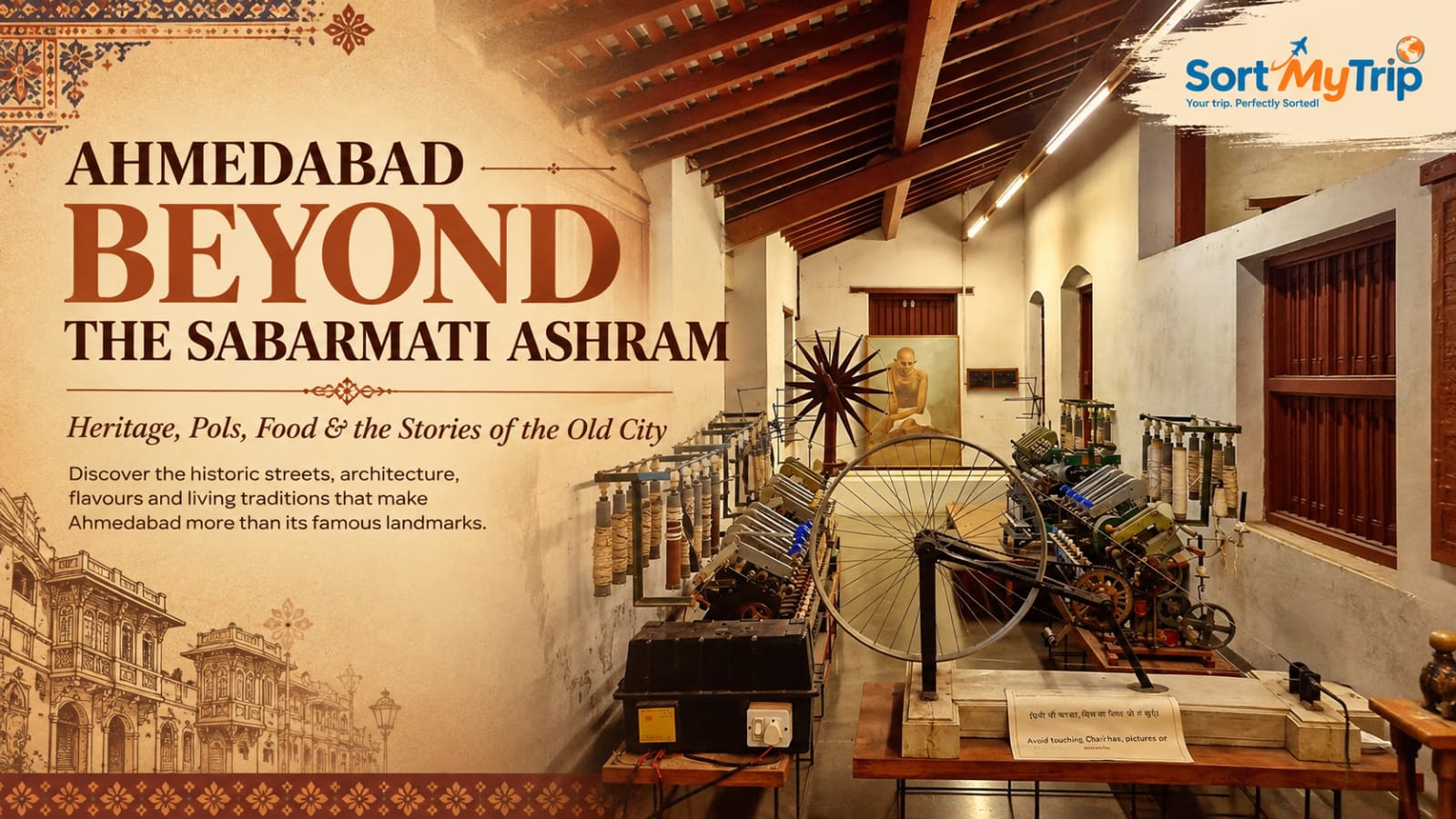
SEO TITLE: Ahmedabad Beyond the Sabarmati Ashram: Heritage, Food, Culture & Hidden Gems
META DESCRIPTION: Explore Ahmedabad beyond the Sabarmati Ashram with old-city pols, heritage architecture, stepwells, museums, food, markets, temples, mosques and cultural experiences.
FOCUS KEYWORD: Ahmedabad Beyond the Sabarmati Ashram
SECONDARY KEYWORDS: Ahmedabad travel guide, places to visit in Ahmedabad, Ahmedabad heritage, Ahmedabad culture, Ahmedabad old city, Ahmedabad pols, Ahmedabad food, things to do in Ahmedabad, Ahmedabad historical places, Ahmedabad tourism, Ahmedabad heritage walk, Sabarmati Riverfront, Adalaj Stepwell, Manek Chowk
URL SLUG: ahmedabad-beyond-sabarmati-ashram
CATEGORY: Gujarat Travel
TAGS: Ahmedabad, Gujarat Tourism, Ahmedabad Heritage, Ahmedabad Food, Ahmedabad Old City, Sabarmati Ashram, Heritage Walk, Gujarat Travel, Indian Architecture, Ahmedabad Culture
Ahmedabad Beyond the Sabarmati Ashram: Discover the City’s Heritage, Food and Culture
Ahmedabad is often introduced to travellers through one iconic place: Sabarmati Ashram.
The ashram is undoubtedly an important part of the city's history and remains one of its most recognisable landmarks. But if your Ahmedabad itinerary begins and ends there, you are seeing only one chapter of a much larger story.
Beyond the ashram lies a city shaped by more than six centuries of history, traditional neighbourhoods, Indo-Islamic architecture, Jain temples, mosques, stepwells, wooden havelis, bustling markets, museums, street food and a vibrant contemporary culture.
The historic city of Ahmedabad was founded by Sultan Ahmad Shah in 1411 and was inscribed on the UNESCO World Heritage List in 2017. UNESCO describes its historic urban fabric as a distinctive combination of monuments, traditional pols, wooden houses, religious buildings and community spaces. (UNESCO World Heritage Centre)
That makes Ahmedabad much more than a stop on a Gujarat road trip.
It is a destination where history can be experienced by simply walking down an old street, looking up at a carved wooden façade, entering a centuries-old mosque or sitting down for a plate of Gujarati food.
If you are planning a trip to Gujarat, it is time to discover Ahmedabad beyond the Sabarmati Ashram.
Ahmedabad: A City Built Through Layers of History
Ahmedabad's history stretches back much further than its modern identity.
The city was founded by Sultan Ahmad Shah in 1411 on the eastern bank of the Sabarmati River. Over the centuries, it developed into an important political, commercial and cultural centre. (UNESCO World Heritage Centre)
Today, this long history remains visible throughout the old city.
You can see it in:
Historic gates
Mosques
Jain and Hindu temples
Traditional pol houses
Wooden balconies
Carved doors
Community courtyards
Stepwells
Markets
Old neighbourhoods
Historic tombs
Traditional craft traditions
UNESCO particularly recognises Ahmedabad's traditional pols, which are closely packed residential neighbourhoods with gates, community spaces, wells, bird feeders and richly decorated wooden houses. (UNESCO World Heritage Centre)
The fascinating part is that this heritage is not confined to a museum.
It is part of the living city.
The Old City: Where Ahmedabad's Story Comes Alive
For travellers interested in architecture and culture, the old city should be one of the first places to explore.
Walking through its narrow streets can feel completely different from the modern parts of Ahmedabad.
Traditional homes stand close to one another, wooden façades display intricate carvings and small lanes lead towards neighbourhood temples, mosques, markets and community spaces.
UNESCO describes these traditional neighbourhoods as an important component of Ahmedabad's urban heritage, with pols generally organised around main streets and accessed through gates or khadkis. (UNESCO World Heritage Centre)
This is one of the reasons a walking tour can be more rewarding than simply visiting individual monuments.
You are not just looking at buildings.
You are experiencing the relationship between architecture, community and everyday life.
Ahmedabad Heritage Walk
One of the best ways to discover the historic city is through a heritage walk.
Gujarat Tourism notes that the Ahmedabad Heritage Walk takes visitors through old neighbourhoods, historic monuments, religious buildings and traditional wooden houses. The official route starts at Kalupur Swaminarayan Temple and ends at Jumma Masjid. (gujrattourism)
The walk is particularly interesting for architecture lovers.
Look closely at the houses rather than simply photographing famous monuments.
Notice the carved wooden entrances.
Look for balconies and traditional façades.
Observe the small community spaces.
You may also come across chabutras, traditional bird-feeding structures that form part of the historic neighbourhood landscape. (UNESCO World Heritage Centre)
The details are what make Ahmedabad's old city special.
Bhadra Fort and Bhadra Square
Bhadra Fort is closely connected with the history of Ahmedabad.
The historic Bhadra area formed an important centre of the old city, and UNESCO identifies the Bhadra citadel and surrounding historic urban fabric among the important heritage elements of Ahmedabad. (UNESCO World Heritage Centre)
Today, the area combines heritage architecture with the energy of the modern city.
Nearby streets lead towards markets, religious landmarks and historic structures.
It is a good place to begin understanding how Ahmedabad's old and new identities overlap.
Teen Darwaza
Located close to Bhadra Fort, Teen Darwaza is another important historic landmark.
The gateway is associated with the historic city and the royal complex around Bhadra.
Rather than viewing it as an isolated monument, explore the surrounding streets as well.
The market activity around the old city helps you understand how these historic spaces continue to function as part of everyday urban life.
Jama Masjid: A Masterpiece of Ahmedabad Architecture
Jama Masjid, also known as Jumma Masjid, is one of the most significant historic religious buildings in the old city.
Its architecture reflects the artistic and cultural environment of the Sultanate period.
The mosque forms part of the historic urban landscape that UNESCO recognises for its combination of Islamic monuments, Hindu and Jain religious buildings and traditional residential architecture. (UNESCO World Heritage Centre)
The surrounding area is equally fascinating.
Walk slowly.
Observe the stonework.
Look at the proportions of the arches and columns.
Then step outside and experience the busy streets around the monument.
That contrast between historic architecture and modern street life is quintessentially Ahmedabad.
Sidi Saiyyed Mosque and the Famous Stone Jali
The Sidi Saiyyed Mosque is one of Ahmedabad's best-known architectural landmarks.
It is especially famous for its intricate stone jali work.
The delicate carving demonstrates the extraordinary craftsmanship found in Ahmedabad's historic architecture.
UNESCO specifically highlights the ornate window of the Sidi Saiyyed Mosque as one of the notable architectural features of the historic city. (UNESCO World Heritage Centre)
For photography enthusiasts, the craftsmanship deserves close attention.
Instead of taking only a wide photograph, spend a few minutes observing the patterns and details in the stone.
Rani Sipri Mosque
Another lesser-discussed architectural gem is Rani Sipri Mosque.
Gujarat Tourism describes the mosque and tomb as notable examples of Ahmedabad's architectural craftsmanship, particularly for their delicate sculptural detailing. (gujrattourism)
It is an excellent addition to a heritage-focused itinerary for travellers who want to explore beyond the city's most famous landmarks.
Hutheesing Jain Temple
Ahmedabad's cultural heritage is not limited to Islamic architecture.
The Hutheesing Jain Temple is another important landmark.
Gujarat Tourism notes that the temple was constructed in 1848 by Sheth Hutheesing and his wife Harkunvarba Shethani. (gujrattourism)
The temple is known for its intricate stone architecture and decorative details.
Visitors interested in architecture should take time to observe the craftsmanship rather than rushing through the site.
The temple also demonstrates the religious diversity that forms part of Ahmedabad's historic identity.
Adalaj Stepwell: An Architectural Journey Near Ahmedabad
If you have an extra half-day, consider travelling outside the city to Adalaj Ni Vav.
Located at Adalaj, around 18 kilometres from Ahmedabad railway station according to Gujarat Tourism, the five-storey stepwell was built in 1499 and is associated with Queen Rudabai. (gujrattourism)
Stepwells were not simply places to collect water.
They could also function as social and architectural spaces.
The elaborate carvings at Adalaj demonstrate the sophistication of the region's traditional stone craftsmanship.
The structure becomes especially interesting when you consider its practical purpose alongside its artistic design.
Sarkhej Roza: A Quieter Side of Ahmedabad's Heritage
For travellers interested in historic architecture, Sarkhej Roza offers another perspective on Ahmedabad.
The complex is associated with the Sultanate-era history of the region and contains architectural elements connected with tombs, mosques and pavilions.
Its atmosphere is different from the busy centre of the old city.
This makes it useful for travellers who want to spend time appreciating architecture without rushing between crowded attractions.
Calico Museum of Textiles
Ahmedabad's cultural story is also closely connected with textiles.
The Calico Museum of Textiles is one of the city's important cultural institutions and is listed by Gujarat Tourism among Ahmedabad's attractions. (gujrattourism)
For visitors interested in Indian textiles, embroidery, weaving and traditional craftsmanship, the museum can add considerable depth to a Gujarat itinerary.
Textiles are particularly relevant to Ahmedabad because the city has long been associated with India's textile industry.
A visit here helps connect traditional craftsmanship with the broader industrial and commercial history of the city.
Visitors should check current opening arrangements and booking requirements before planning a visit, as museum access can be subject to specific visitor rules.
Ahmedabad's Textile and Industrial Legacy
Ahmedabad's heritage is not only about medieval monuments.
The city also played a major role in India's modern industrial history.
Its textile mills helped shape its economic identity and contributed to its reputation as an important textile centre.
This industrial heritage provides an interesting contrast with the traditional handcrafts visible in Gujarat's villages.
In one trip, travellers can encounter centuries-old wooden architecture, historic mosques and temples, traditional textiles and the legacy of modern industry.
Sabarmati Riverfront: The City's Modern Face
After exploring the old city, head towards the Sabarmati Riverfront to experience a very different side of Ahmedabad.
Gujarat Tourism describes the Riverfront as a planned 22-kilometre promenade developed as part of the city's riverfront transformation. It includes spaces for walking, recreation, boating and events. (gujrattourism)
The riverfront is particularly pleasant during the cooler parts of the day.
Early morning and evening walks allow visitors to experience the city at a slower pace.
It is also a useful reminder that Ahmedabad is not frozen in its historical identity.
The city continues to evolve.
Manek Chowk: Ahmedabad After Dark
If you want to experience Ahmedabad through food, make time for Manek Chowk.
The historic market area changes character as the day progresses.
By evening and night, food stalls become an important part of the experience.
You can find a wide variety of Gujarati snacks, sandwiches, sweets and other popular street foods.
For first-time visitors, it is one of the easiest places to experience Ahmedabad's energetic food culture.
Try local favourites such as:
Gujarati snacks
Dabeli
Pav-based snacks
Sandwiches
Jalebi
Kulfi
Fafda
Khaman
Dhokla
Food preferences and hygiene conditions can vary between vendors, so choose busy, well-maintained stalls and use normal food-safety precautions.
Ahmedabad Food: More Than Street Snacks
Ahmedabad's food culture deserves more than one evening at Manek Chowk.
The city is an excellent place to experience Gujarati cuisine.
A traditional Gujarati thali can include:
Roti or rotla
Dal
Kadhi
Shaak
Khichdi
Farsan
Pickles
Chutneys
Papad
Chhaas
Sweets
The combination of sweet, savoury, sour and spicy flavours is one of the defining characteristics of Gujarati food.
For travellers, a thali is one of the simplest ways to sample multiple dishes in one sitting.
Law Garden Night Market
For travellers who enjoy shopping and local culture, Law Garden is another useful stop.
The area is associated with evening shopping and street food, and Gujarat Tourism's Ahmedabad material includes Law Garden among the city's shopping experiences. (gujrattourism)
Depending on the season and current market arrangements, you may find colourful Gujarati clothing, embroidered products, handicrafts, jewellery and accessories.
It is a good place to look for souvenirs that reflect Gujarat's textile and craft traditions.
Kankaria Lake: A Different Ahmedabad Experience
Not every Ahmedabad attraction needs to be historic.
Kankaria Lake provides a recreational side of the city and is listed by Gujarat Tourism among Ahmedabad's attractions. (gujrattourism)
The area can be incorporated into a family-friendly itinerary, particularly for travellers looking for an evening activity after sightseeing.
It demonstrates another aspect of Ahmedabad: a modern urban destination with recreational spaces alongside its historic core.
Museums for Curious Travellers
Ahmedabad has several museums and cultural institutions that can enrich a trip beyond the standard sightseeing circuit.
Depending on your interests, consider exploring:
Calico Museum of Textiles
Lalbhai Dalpatbhai Museum
Sardar Vallabhbhai Patel National Memorial
Auto World Vintage Car Museum
Sanskar Kendra
Gujarat Tourism currently lists museums as one of the major categories for exploring Ahmedabad. (gujrattourism)
Before visiting a museum, check current opening days, entry rules and photography policies.
A City of Many Communities and Traditions
One of the most fascinating aspects of Ahmedabad is its cultural diversity.
UNESCO notes that the historic city's urban structure contains institutions associated with multiple religious traditions, including Hinduism, Islam, Jainism, Christianity, Buddhism, Zoroastrianism and Judaism. (UNESCO World Heritage Centre)
This diversity can be experienced through architecture, food, festivals, neighbourhoods and places of worship.
It is one of the reasons Ahmedabad's heritage cannot be reduced to a single monument or historical personality.
The city is a collection of communities, traditions and architectural styles that have developed alongside one another.
Ahmedabad Beyond the Sabarmati Ashram: A 2-Day Itinerary
If you have two days in Ahmedabad, you can explore much more than the ashram.
Day 1: Old Ahmedabad
Start early with the historic city.
Explore:
Kalupur
Traditional pols
Bhadra Fort
Teen Darwaza
Jama Masjid
Sidi Saiyyed Mosque
Historic markets
Manek Chowk
Take a heritage walk if the schedule works for you.
Gujarat Tourism's official heritage walk route starts at Kalupur Swaminarayan Temple in the morning and concludes at Jumma Masjid. (gujrattourism)
In the evening, explore Manek Chowk for local food.
Day 2: Architecture, Museums and the River
Begin with one or two cultural attractions such as Hutheesing Jain Temple or Calico Museum of Textiles.
Then explore the Sabarmati Riverfront.
If you prefer architecture and have additional time, make a half-day excursion to Adalaj Ni Vav.
Return to Ahmedabad for an evening meal.
This itinerary allows you to experience the city's historical, cultural and contemporary sides without rushing through every attraction.
Best Time to Visit Ahmedabad
The cooler months are generally more comfortable for sightseeing, particularly if you plan to spend substantial time walking through the old city.
October to March is commonly considered a convenient period for exploring Gujarat.
Winter mornings can be especially pleasant for heritage walks.
If you visit during hotter months, plan outdoor sightseeing during the morning and evening and keep the afternoon for museums, cafés or indoor attractions.
How to Explore Ahmedabad Responsibly
Ahmedabad's heritage is not simply a collection of tourist attractions.
People continue to live and work within many of its historic neighbourhoods.
Keep this in mind while exploring.
Respect residential areas: Traditional pols are living neighbourhoods, not open-air museums.
Ask before photographing people: Especially inside homes, workshops and places of worship.
Dress appropriately: Follow local expectations when visiting religious sites.
Avoid littering: Historic neighbourhoods and riverfront spaces benefit from responsible tourism.
Support local businesses: Eat at local establishments and purchase authentic handicrafts where possible.
Walk slowly: The details of Ahmedabad's architecture are often found in doors, balconies, carvings and small community spaces.
Why You Should Explore Ahmedabad Beyond the Sabarmati Ashram
Sabarmati Ashram tells an important part of Ahmedabad's modern history.
But Ahmedabad's identity is much larger.
It is a city of pols and palaces, mosques and temples, markets and museums, stepwells and riverfronts, street food and traditional thalis.
Its old city tells the story of a community-oriented urban culture.
Its monuments reveal the architectural history of Gujarat.
Its museums preserve textiles, art and heritage.
Its markets show the energy of contemporary Ahmedabad.
And its food offers one of the easiest ways to connect with local culture.
UNESCO's recognition of the Historic City of Ahmadabad reflects this broader heritage, particularly its traditional urban form, architecture and multicultural character. (UNESCO World Heritage Centre)
So, the next time someone mentions Ahmedabad, don't think only of the Sabarmati Ashram.
Think of the narrow lanes of the old city.
Think of carved wooden houses.
Think of the sound of the market.
Think of a Gujarati thali.
Think of a centuries-old mosque beside a bustling modern street.
Think of an evening along the Sabarmati Riverfront.
That is Ahmedabad beyond the Sabarmati Ashram.
Let SortMyTrip Help You Explore Ahmedabad
Planning an Ahmedabad trip can be much more rewarding when the itinerary combines heritage, food, culture and nearby attractions rather than focusing on only one landmark.
From the historic pols and monuments of the old city to Adalaj Ni Vav, museums, markets and the Sabarmati Riverfront, there are many ways to experience Gujarat's largest city.
Let SortMyTrip Help you with this curated package and create a customised Gujarat itinerary based on your travel dates, hotel preferences, sightseeing interests and budget.
Whether you are planning a family holiday, couple trip, heritage journey or a larger Gujarat tour covering Ahmedabad, Kutch, Vadodara, Dwarka and Somnath, a well-planned itinerary can help you experience the region at a comfortable pace.
Frequently Asked Questions About Ahmedabad
What is Ahmedabad famous for besides Sabarmati Ashram?
Ahmedabad is known for its historic old city, UNESCO World Heritage heritage, traditional pols, mosques, temples, stepwells, textiles, museums, Gujarati cuisine, markets and Sabarmati Riverfront. (UNESCO World Heritage Centre)
Is Ahmedabad a UNESCO World Heritage City?
Yes. The Historic City of Ahmadabad was inscribed on the UNESCO World Heritage List in 2017. (UNESCO World Heritage Centre)
What are the best heritage places to visit in Ahmedabad?
Important heritage attractions include Bhadra Fort, Jama Masjid, Sidi Saiyyed Mosque, Rani Sipri Mosque, traditional pols, Hutheesing Jain Temple and nearby Adalaj Ni Vav. (UNESCO World Heritage Centre)
What is a pol in Ahmedabad?
A pol is a traditional residential neighbourhood in the historic city, generally organised around a main street and accessed through gates. UNESCO describes pols as an important part of Ahmedabad's traditional urban heritage. (UNESCO World Heritage Centre)
Is Ahmedabad good for food lovers?
Yes. Ahmedabad offers Gujarati thalis, farsan, street food, sweets and popular evening food markets such as Manek Chowk.
How many days are enough for Ahmedabad?
Two days can provide a useful introduction to the historic city, food and major attractions. Three days or more allows additional time for museums, Adalaj Ni Vav and a slower exploration of the city.
What is the best way to explore old Ahmedabad?
Walking is particularly useful because many of the historic neighbourhoods and architectural details are located along narrow streets. Gujarat Tourism officially promotes a heritage walking route through the old city. (gujrattourism)
Is Adalaj Stepwell inside Ahmedabad?
Adalaj Ni Vav is located in Adalaj, outside Ahmedabad, and Gujarat Tourism places it about 18 km from Ahmedabad railway station. (gujrattourism)
What food should I try in Ahmedabad?
Try a Gujarati thali, khaman, dhokla, fafda, jalebi, dabeli, thepla, khakhra and other regional snacks. Manek Chowk is one of the city's well-known areas for evening food.
Can Ahmedabad be combined with other Gujarat destinations?
Yes. Ahmedabad can serve as a starting point for wider Gujarat journeys covering destinations such as Kutch, Vadodara, Dwarka, Somnath, the Statue of Unity and other heritage and cultural destinations. Gujarat Tourism currently organises its destination offerings across heritage, cuisine, museums, religious sites and other travel themes.